
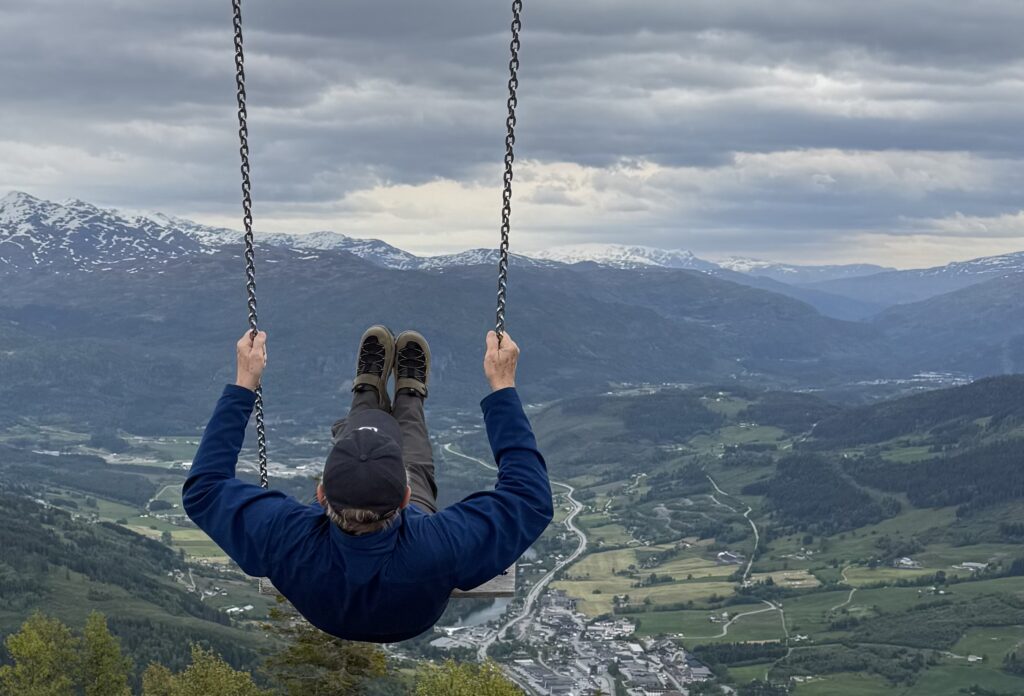
Here I am, suspended high above the valley in Voss, Norway—nothing but chains in my hands, open air beneath my boots, and a vast alpine landscape stretching out in every direction.
It’s a good metaphor for entrepreneurship.
Risk looks glorious in hindsight, especially when there’s a photo to capture the view. But when you’re in the moment—dangling between security and possibility—it’s not romantic.
It’s real. It’s personal. It’s terrifying and exhilarating, often in equal measure.
I’ve built companies, faced market headwinds, made hires I regretted, and signed contracts that kept me up at night.
Through it all, one thing became crystal clear—risk is not for everyone.
Some people romanticize entrepreneurship. They see founders as visionaries or mavericks. Others think we’re reckless. The truth is, they’re both a little right—and a little wrong.
The reality? Risk can be stressful. It can be destructive—especially if you don’t have the stomach for ambiguity, failure, or financial uncertainty.
I’ve seen brilliant people burn out trying to force themselves into roles that didn’t align with their risk tolerance. That’s not failure. But if they learn from it, that’s self-awareness.
If you do have the wiring for it, though, risk can be your greatest asset.
I wasn’t successful because I took risks. I was successful because I believed in my vision for what the market needed.
I had an almost irrational determination to succeed—and, I’ll admit, a kind of numbness to failure as an outcome. I never wanted to fail, but I didn’t fear it the way others did.
And I learned. I got better. Experience taught me how to navigate the human dynamics of a growing team, the unpredictability of markets, and the unforgiving math of cash flow.
I didn’t eliminate risk—but I learned how to take smarter risks.
So if you’re out there and people are calling you reckless because you’re chasing a vision they can’t see—ignore them. They’re looking up at the swing and imagining the fall. You’re looking out at the horizon.
Just make sure you know yourself. Understand your own capacity for stress, for uncertainty, and for loss.
Don’t mistake recklessness for bravery—or caution for cowardice. Risk, when matched to the right temperament, is not foolish. It’s strategic.
This photo captures a moment of joy and freedom—but it didn’t happen without the climb, without the courage to push off the platform, without trusting the chains to hold.
Business is no different.
Here’s to the calculated leaps, the gut-driven decisions, and the grit to keep swinging—even when the wind picks up.
Ever taken a swing at something that scared you? Hit reply or comment and tell me what happened—whether you flew or fell—and what you learned from it.